
Career Change: Compare Routes and Build an Action Plan
Build your career action plan
Choose a role, check the gaps and keep track of your next actions.
Saving uses this device.
Print, download or reset

A career change starts with the work you want to do and the skills you can already show. Compare entry rules, daily demands, study time and complete training costs before buying a course. Use one target route and one fallback to build a practical action plan. A course or certificate does not guarantee a job or higher pay.
Define the work you want to change
Be specific about what needs to change. You may want different tasks, a steadier schedule, less travel or a new field. Changing employers can address some of those needs without changing careers. A new certificate won't necessarily solve a problem caused by the setting rather than the work.
Describe a useful working day. State the tasks, hours and type of contact you want. Then note what you need to avoid. This gives you a basis for comparing roles beyond their titles or advertised pay.
Choose one role to investigate first. You can change that choice as you learn more. Trying to study for every possible route at once can make it hard to tell which skill gap matters. A target and a fallback keep the research focused without locking you into a purchase.
Use the short training route comparison for a broad view of project, office, medical, legal, bookkeeping and IT routes. Its pay figures describe occupations, not what a new course graduate can expect. Read the work and entry fields along with the amounts.
Audit transferable skills and constraints
A transferable skill is a task you can use in a different setting. Naming it isn't enough; add an example. "Communication" could mean writing a clear handoff, explaining a problem to a client or resolving a team misunderstanding. Those examples help you see where the skill fits.
Build a short evidence list:
- A task you performed and why it mattered.
- The setting and the people involved.
- Your actual responsibility, separate from the team's work.
- A record or example you can describe without disclosing private information.
- The gap between that task and the target role.
Don't inflate the example to match a new title. A real support task can be useful without claiming you led a whole project. Keep the facts clear enough that another reader can follow what you did.
Put constraints beside skills
Skills alone don't decide fit. Record the study time you can sustain, work hours you need, travel limits and any required equipment. If a course has live sessions or fixed module dates, compare those with your actual week. Flexible online delivery can still involve deadlines.
Money needs a similar scope check. Separate the learning purchase from any exam, materials, travel or recurring access. A missing required amount means the total is incomplete. Don't use an occupation median to fill that gap or assume a future salary will cover it.
Keep these notes in your own plan. This site doesn't need your work records or personal budget to explain the route. Use blank examples or remove private details from any practice work you choose to share.
Compare entry routes and training costs
Separate course entry from career entry. A course may accept beginners while employers expect further education or experience. A provider certificate may also differ from the professional credential named in a role description.
For example, PMI's CAPM requires age 18, a secondary degree or equivalent and 23 hours of project education before its exam. It doesn't require project experience. PMP, also issued by PMI, has education and project leadership routes. A short project course doesn't automatically award either.
This distinction applies beyond project work. A medical coding course is preparation, not automatically the coding credential. A paralegal education certificate isn't NALA's CP award. A Google IT course isn't CompTIA A+. The matching career guide should name the real issuer and the steps still needed.
Use the same fields for each route
Write down duties, entry rules, study and the award. Then add work setting and complete cost. If one route needs a prior degree, don't compare its short final course with another route's full beginner training as though both start from the same point.
Check the source for each fact. The credential issuer owns eligibility. The course provider owns its current syllabus and purchase terms. BLS describes occupation pay and typical entry patterns. A seller's salary claim doesn't establish what you'll earn.
If a route has an unclear prerequisite, name the missing fact. You can keep researching the work while you resolve it. Don't spend on advanced preparation simply to feel that the career change has started. A clear answer to the entry question may be the more useful first result.
Build evidence before applying
Choose a small task that resembles the work. For project support, draft a brief and action log for a sample change. For bookkeeping, work through a set of invented transactions and check them. For IT support, explain a safe troubleshooting sequence and its result.
Label course work and practice tasks honestly. They show learning rather than employment. Don't present a made-up client, a private employer record or someone else's template as your own completed work.
Make the task useful to review
State the goal before doing the task. Then record your choices and why they fit. A reviewer should be able to follow the reasoning without guessing what the exercise was meant to show. The work can be simple; it needs to be clear and accurate.
After the first attempt, inspect one weakness. You might need better notes, stronger checking or a clearer way to explain a trade-off. Revise that part, then see whether the change helped. This gives you a more specific learning need than a general wish for another certificate.
Use role descriptions as evidence
Read duties and required skills in the roles you're considering. Separate a firm requirement from a preference. Look for patterns across relevant roles, but don't invent a frequency or market-wide conclusion from a few examples. The point is to find concrete tasks to investigate.
Keep application language tied to what you can show. Use the actual award name and completion status. Explain transferable tasks in the new field's plain language without changing the facts. A clear example is stronger than a long list of broad skill words.
Career action plan
Make a plan with your target role, current skills and next checks. Write down the issuer, any training gaps and the order of your next actions.
- Target role and why it interests you.
- Work or study evidence you can show.
- Entry rules and the issuer that sets them.
- Skills or study you still need.
- One fallback role and its trade-offs.
- The next action and a date to review it.
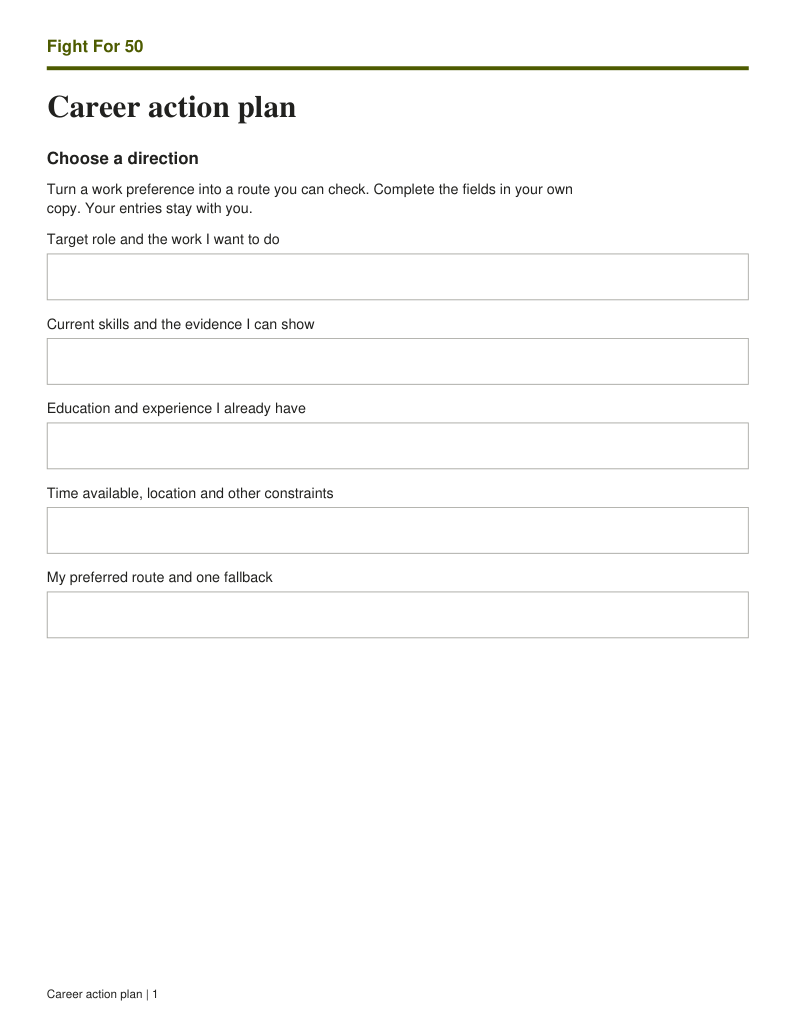
Plan your next career move
Choose a target role, keep one fallback and set out the checks to make next.
For adults choosing a new work direction. Includes a fillable, printable PDF, an editable document, a source checklist and a fictional planning example.
Follow-up emails help you check entry requirements, compare training and choose your next step.
Is there a charge?
The files are free.
How do I get the files?
Links appear after you submit and arrive in your welcome email. Save your copies while the links are valid for seven days.
Can I edit or print them?
Fill in the PDF or edit the document. Print on US Letter or scale to fit A4.
A transition example
A reader has worked in general office support and wants project coordination. They have kept meeting notes and helped with an office move. They record their actual role rather than assuming every office year counts as project leadership.
Their first action is to compare coordinator duties with those examples. Their next action is to inspect PMI's entry credential and a beginner course. They then choose one small project-planning exercise to test the learning gap. No job date or salary is assumed.
The fallback is another office role with the schedule they need. That fallback isn't a failure; it is a way to compare the change with a nearer option. The plan remains useful even if the reader decides a new employer would address the main problem.
Put actions in a workable order
First verify the fact that could rule the route out, such as a degree prerequisite or required live attendance. Next choose the learning or practice that closes a real gap. Then prepare applications with accurate evidence. Don't put an expensive course before a basic entry check just because the purchase is easier to complete.
Choose your own review date after an early action. At that point, ask what new evidence you have and what you still need to find out. Keep going, narrow the goal or change route based on that evidence. The plan doesn't assign an automated suitability score.
Review the choice before the next purchase
Compare the result of the first task with your original reason for changing work. A useful course may teach a skill without solving a schedule problem. A promising role may still require travel you cannot sustain. Keep both facts visible rather than treating learning progress as proof of overall fit.
Record what would change the decision. You may need a clear answer about entry, a different study mode or evidence that you enjoy the task. That gives the next check a purpose. It also makes it easier to stop buying similar courses that don't address the unresolved gap.
Your fallback should be specific enough to compare. Name the role and the reason it remains useful. Then use the same evidence fields for both options. A fallback chosen only because it sounds easy won't help if its real duties have never been checked.
Plan for your life stage
The same role can fit differently depending on current commitments. A reader with a fixed work schedule may need evening study. Another may value predictable hours more than remote work. Don't infer those needs from age or a career label; record your own constraints.
Our career change at 50 guide focuses on using existing evidence and planning a staged transition. It doesn't assume a shared reason for changing work or promise an easier route for a particular age group.
If a household commitment affects study or travel, put it on the plan before choosing a programme. A realistic constraint helps you choose. It isn't a reason to hide the workload or claim that a course is effortless.
Choose a career guide
Use the guide that matches the work, then inspect its entry and training route:
- Project management: compare PMP, CAPM and course learning.
- Medical billing and coding: separate the roles and credentials.
- Paralegal careers: compare education and professional awards.
- Administrative assistant work: inspect daily office tasks and skills.
- Bookkeeping: compare the work, training and credential choices.
- IT help desk: understand user support before choosing a course.
For general US career exploration, CareerOneStop is a Department of Labor career resource. Use primary issuer and provider pages for the final credential or purchase decision. A general career tool doesn't settle a professional exam application.
Do I need to start from zero?
Not necessarily. Use evidence of tasks you already perform, then name the gaps that are specific to the new role. Don't assume every past task transfers without more learning.
Should I buy a certificate before choosing the work?
Choose the role and requirement first. Then buy teaching or an exam only when you can explain what it adds to the plan.
How do I judge progress?
Use completed actions and better evidence: a checked entry rule, a revised work sample or a clearer role choice. A course purchase alone isn't proof of a completed career change.
https://fightfor50.com/career-change/