
Career Change at 50: Compare Training, Time and Transferable Skills

Fight For 50 · Facts checked November 2026
A career change at 50 should use your existing experience while testing the demands of the new work. Compare the full entry route, a study schedule you can sustain and the complete costs. Age alone doesn't choose the role or the credential for you. A course or certificate does not guarantee a job or higher pay.
Clarify the change and your constraints
Name what you want to change about work. It may be the tasks, setting, schedule or field. A change of employer may address some needs without a new career. A course is useful when it closes a real gap, rather than simply marking a fresh start.
Write a short description of the working day you want. Include the duties, type of contact, travel and hours. Then list any limits you need to keep. Don't assume that a role described as remote or office-based has the schedule you want.
Keep one target role and one fallback. This gives you a clear place to begin research without treating the first choice as final. You can revise the plan as you learn more about entry rules and the actual work.
The main career-change guide explains the broad route from skills to learning and applications. This page adds a staged approach for a reader who wants to make good use of a longer work history and current commitments. It doesn't assume all readers at 50 have the same family, finances or goals.
Put the hard limits first
If you can study only at certain times, check live sessions and module dates before a course's advertised duration. If travel is limited, inspect practical attendance and test-centre needs. A short online lesson doesn't establish the full route's location requirements.
Keep your budget in your own plan. Record what you can spend and when a payment is due, without assuming a future wage rise. This guide doesn't estimate retirement effects, investment returns or course payback. Those aren't needed to compare the training task.
Translate existing experience into role evidence
A longer work history can contain useful evidence, but it needs a clear description. Start with tasks you actually performed. State the setting, responsibility and result you can support. A job title or number of years alone doesn't explain what transfers.
For each relevant example, write:
- What problem or task you worked on.
- What you personally did.
- Who else held decisions or approval.
- What record or outcome you can truthfully describe.
- What the target role adds that you haven't yet done.
Keep private data out of shared samples. Describe a work process without exposing client, patient or employer records. If you use a practice exercise instead, label it as an exercise. It can still show learning and reasoning.
Avoid two common evidence gaps
The first is describing a broad trait without an example. "Organised" means little until you show how you kept work on track. A clear handoff, checked record or well-run task gives it meaning.
The second is overstating a task to match a new title. Helping with a project isn't the same as leading it. Maintaining a spreadsheet isn't automatically full bookkeeping responsibility. Use the accurate task and then identify the next skill to learn.
This method also helps you decide what not to repeat. If you already do a basic task well, another introductory course may add little. You may need a sector-specific rule, a different tool or a professional exam instead. Choose the gap after reviewing the evidence.
Compare training time and full costs
Separate admission, study and career entry. A course can be open to beginners while the professional credential has an experience requirement. A programme can fit your study horizon but still leave an external exam or further education to complete.
PMI's CAPM is one entry-credential example. It requires age 18, a secondary degree or equivalent and 23 hours of project education before its exam; no project experience is required. PMI's PMP uses different education/project leadership routes. Your age doesn't replace the issuer's evidence requirements.
ExpertRating can offer a short first course or preparation, but its own certificate isn't PMI PMP/CAPM or another issuer's credential. Read the actual syllabus and award. A low course fee isn't proof that the full entry route is short or inexpensive.
Compare the same scope
For each option, record teaching, assessment, access and support. Add an external exam only if it is part of your chosen route. Keep optional materials or retakes in separate cases. If you still need a required fee, put it on the list of costs to check.
Put the paid period beside a recurring price. A monthly course may cost more if you study slowly. A fixed-access course may need an extension. Neither model is always better. Compare the terms with your actual schedule.
Don't let a deadline remove the practice. If the required work doesn't fit your available hours, choose a longer plan or a narrower first goal. The value is the learning you can use, not the fastest date you can place beside a certificate.
Check pay, demands and local requirements
Use the exact occupation when reading pay data. A broad administrative median isn't automatically a medical office wage. A computer user support figure differs from network support. A project management specialist series may describe a different entry pattern from a coordinator role.
The linked career guides use dated BLS references where pay is discussed. A national median describes a group of workers with varied experience. It isn't starting pay or a promise of what a career changer will receive. Read role, location, hours and actual terms when comparing work.
Look at demands as well as pay. A desk role may involve constant contact or tight deadlines. A trade may require physical work, travel and licensing. A remote role can still require fixed shifts or a quiet workspace. Check the specific setting rather than a broad "low stress" label.
Verify the route at the right source
The credential issuer owns exam eligibility. The school or provider owns its syllabus and enrollment terms. A regulator owns a licence rule. An employer owns its actual hiring requirements. Use each source for the fact it can establish.
When a page is unclear or two official pages disagree, keep the fact unresolved. Don't select the answer you prefer and build the plan around it. You can continue other useful research while you verify the gap.
Build a staged action plan
Use stages with evidence at each point. They don't need a universal calendar. The right timing depends on what you must check and the work needed. A staged plan lets you revise a choice before spending more time or money.
Stage one: check the role
Read duties and entry rules for the target and fallback. Compare the work with your constraints. Name the fact most likely to rule a route out. Verify that first, such as a degree prerequisite, required attendance or a long experience condition.
Stage two: test the learning gap
Choose a small relevant task. For project support, draft a brief and action record. For IT support, explain a safe diagnosis and handoff. For bookkeeping, work through invented transactions and check the records. Use the task to learn what you still need.
Stage three: choose the teaching or credential
If a course is useful, compare content and complete cost before enrolling. If an external award fits, read the issuer's current route. If the evidence suggests the work isn't a fit, change direction without treating that finding as failure.
Stage four: prepare accurate applications
Describe the relevant tasks from your past work and the new learning separately. Use the actual award name. Don't claim a professional credential until it is earned. Keep a work sample small enough that another reader can understand what it shows.
- Target role and why it interests you.
- Work or study evidence you can show.
- Entry rules and the issuer that sets them.
- Skills or study you still need.
- One fallback role and its trade-offs.
- The next action and a date to review it.
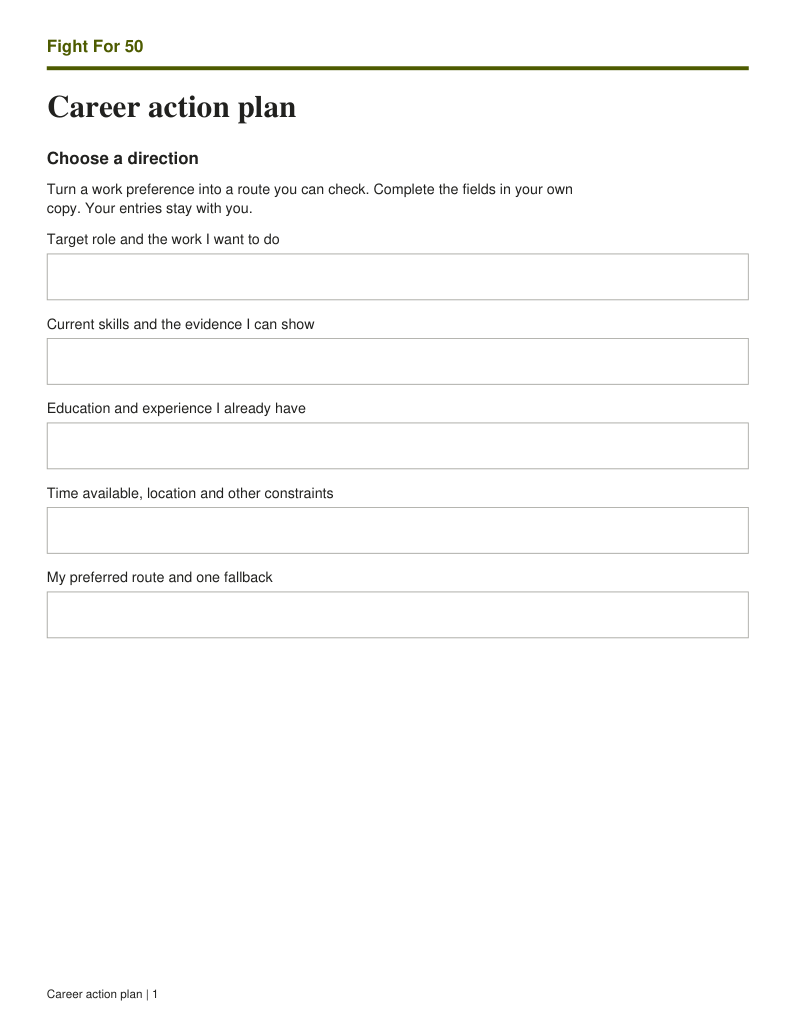
Plan your next career move
Choose a target role, keep one fallback and set out the checks to make next.
For adults choosing a new work direction. Includes a fillable, printable PDF, an editable document, a source checklist and a fictional planning example.
Follow-up emails help you check entry requirements, compare training and choose your next step.
Is there a charge?
The files are free.
How do I get the files?
Links appear after you submit and arrive in your welcome email. Save your copies while the links are valid for seven days.
Can I edit or print them?
Fill in the PDF or edit the document. Print on US Letter or scale to fit A4.
A midlife planning example
A reader has years of office experience and wants less travel. They first compare whether a different office setting would solve the problem. They also investigate project coordination because they have supported defined workplace changes.
They list their actual responsibility in those changes. They don't assume a long career automatically equals qualifying PMP leadership. Their next step is to inspect the entry route and try a small planning exercise. The fallback remains a nearer office role with a better travel pattern.
Its useful result is an ordered plan with evidence to check. The reader chooses the review date after the first task, then decides whether to continue, narrow or change the route.
Use a review point that answers a real question
Choose the review point after a meaningful task, such as reading the full entry rules or finishing a sample exercise. A date on its own doesn't show progress. The question is what new evidence is available when you reach it.
You might learn that the work fits but the course schedule doesn't. In that case, compare another teaching mode before changing the whole career goal. You might learn that the day-to-day task isn't what you want. That is a reason to revisit the role, even if a certificate could be finished quickly.
Keep a simple record of the reason for any change. It can be a sentence, not a long report. This helps you avoid circling back to the same option without remembering the constraint that ruled it out.
The staged approach also lets you use existing evidence well. A skill that transfers can reduce a learning gap. It doesn't remove a formal requirement unless the issuer or employer says so. Keep that distinction clear when a route seems shorter because you already know some of the work.
Applications and the next guide
Return to the career-change guide to choose a career family and its maintained entry guide. Use one next action: check a rule, compare a course or improve a work sample. A clear action is easier to complete than a general promise to start again.
Is 50 too late to change careers?
Age alone doesn't answer whether a route fits. Compare the actual work, requirements, time and your own constraints.
Should I hide earlier experience?
Use relevant, accurate evidence. Explain how the task fits the new work without changing the facts or assuming that every old duty transfers.
Do I need a new degree?
It depends on the occupation, employer and credential route. Verify the actual requirement before buying a short course as a substitute.
https://fightfor50.com/career-change/at-50/