
3 Credential Routes: What Certification Should I Get in 2026?

Fight For 50 · Facts checked November 2026
What certification should I get? Start with the work you want and the evidence you already have. Then choose between an experienced-practitioner credential, an entry credential and a course certificate. A similar title doesn't make those awards equivalent. A course or certificate does not guarantee a job or higher pay.
The short answer
If you've led projects and can support PMI's entry rules, investigate PMP. New project workers seeking an external knowledge credential can investigate CAPM. For a learning gap, a job-skills course may be the useful first step. These are different routes, rather than a single ranking.
For another occupation, use the same method: name the role, find the real issuer and check its requirements. Don't choose a certificate because an ad puts a high salary beside it. Occupational pay and course completion are separate facts.
Our top 3 picks
 1. Experienced-practitioner certification: PMI PMP, subject to documented eligibility.
 2. Entry project credential: PMI CAPM, with education and exam requirements.
 3. Job-skills course certificate: Google's project programme as a broad learning example.
The choice depends on your gap. We compared the named issuer and provider rules. The programme or issuer decides entry and award; the employer decides its hiring requirements.
Start with the job and your current experience
Use a real role description to define the work. "Office work" is too broad to choose an award. Scheduling appointments, coding medical records, maintaining accounts and coordinating a project need different knowledge. Two roles with similar titles may also have different scope.
Separate the duties from the award list. A job description may require a credential, prefer one or simply list relevant learning. Those statements aren't the same. Don't buy an external exam just because one employer listed it as a preference for a role you may not want.
A decision path you can read without a quiz
- Name one target role. State the work you expect to do, the setting and any hard schedule limits.
- List the required entry facts. Separate a degree, experience, a professional exam and a legal licence.
- Check the issuer. Read the current rules on its own site, with the exact award name.
- Compare your evidence. Record what you can prove, what is missing and what you still need to check.
- Choose the immediate gap. It may be teaching, practice, an application record or an exam.
- Choose one route and one fallback. Don't buy every related certificate before deciding what each would do.
Use the path to choose what to learn and which entry rules to check. If the issuer's rule is unclear for your situation, keep that item unresolved. Don't replace it with a course seller's promise.
Use evidence rather than a job title alone
Write what you actually did. If you organised a work change, identify its goal, dates and the decisions you owned. For accounts work, describe the records and checks you handled. In user support, explain the safe steps you took and when you escalated.
Keep classroom work separate from employment. A course case can show learning, but it doesn't become paid experience. A polished template isn't proof that you led the work behind it. Use an accurate label for each example.
Think about constraints before comparing prices. A course that requires live attendance may be wrong for a changing shift. A degree prerequisite can rule out an otherwise short programme. A long experience requirement can't be solved by finding a cheaper version of the exam course.
1. Experienced-practitioner certification
PMI's Project Management Professional, or PMP, is an example of a credential built around prior work. It makes sense to investigate when you've led projects and the roles you want value the award. It is a poor first purchase when the main gap is basic project skills or missing work experience.
- Issuer and award
- Project Management Institute; PMP professional certification.
- Secondary education route
- 60 non-overlapping months leading projects in the past ten years.
- Associate-level route
- 48 months, with the recognised or formally mapped qualification PMI defines.
- Bachelor-level route
- 36 months, with the recognised degree or mapped equivalent.
- GAC degree route
- 24 months with a qualifying GAC-accredited bachelor's/postgraduate degree.
- Other requirements
- Eligible project training, application and exam. Active CAPM has a training-credit route.
- Limit
- A short course can't create past project leadership.
- Source: PMI PMP outline, July 2026, eligibility section. Checked November 2026.
The education level needs evidence. A qualification with "advanced" in its name isn't automatically bachelor-equivalent. Use the official mapping PMI describes. This matters because the accepted qualification changes the months of project work required.
Project work also needs a clear scope. Running a repeated service isn't automatically leading a project. A defined change, such as a system rollout, can be a project even if your title didn't say project manager. Describe the facts and let the issuer apply its rules.
When this route makes sense
It makes sense when the work evidence is present and the credential serves a clear role need. Your first task may be gathering records and checking the route. Buying more beginner teaching may not be the highest-value step.
If you need training, choose a product aligned with the active exam outline and current entry rules. Books and practice tests alone don't satisfy PMI's formal training requirement. A provider's use of "PDUs" also needs care: development for renewal and training for entry serve different purposes.
PMI updated PMP in July 2026 and announced a live-training rule change for December 1, 2026. Match the course mode and completion date to the applicable rule. A current-exam label doesn't prove every entry statement elsewhere on a seller's page is current.
- Source: PMI's exam and training update. Checked November 2026.
When to choose a different first step
Choose a different step if you cannot document the required work. A foundation course may help you enter project support. CAPM may be a better external credential to investigate. Neither choice means you should claim PMP before meeting its rules.
Also reconsider if the target work doesn't need project leadership. A coding, bookkeeping or technical support role may value a different credential or task evidence. A respected award in the wrong field can still be the wrong use of study time.
2. Entry project-management credential
PMI's Certified Associate in Project Management, or CAPM, is the entry credential in this comparison. It doesn't require project work experience. It still has a named issuer, education conditions, an exam and maintenance.
- Issuer and award
- PMI; CAPM professional certification.
- Entry
- At least 18, a secondary degree or equivalent, and 23 hours of project education before the exam.
- Assessment
- PMI exam, separate from any course provider's assessment.
- Cost components
- Required education if needed, exam, optional materials/membership and later renewal.
- Maintenance
- 15 professional development units in each three-year cycle, plus the renewal fee.
- Limit
- It doesn't prove experience leading real projects.
- Sources: PMI CAPM and maintenance rules. Checked November 2026.
This route can fit someone entering project coordination or support who wants an external knowledge award. It isn't required for every entry role. Read actual duties and employer requirements before using it as the centre of your plan.
Match teaching to what the exam covers
CAPM includes project fundamentals, predictive methods, agile methods and business analysis. Learn what those approaches mean through small cases. A predictive plan sets much of the work in advance. Agile uses feedback in short cycles. Business analysis asks what is needed and whether the result meets that need.
A course can help with that learning and may provide the required education hours. Save the actual syllabus and completion record. Don't assume every general project course provides accepted hours. A seller's own award isn't the CAPM credential.
Use practice to identify a specific gap. If you understand a term but choose weak actions in cases, work on applying it. If the terms themselves are new, start with teaching. Repeating a question bank without learning the reason can make progress look stronger than it is.
Plan beyond the exam
Build honest work evidence alongside the study. You could create a small project brief and explain how scope, tasks and risks connect. Label it as an exercise. If you have real support work, describe the responsibility you held without inflating it.
After earning CAPM, maintain it under PMI's rules if you keep using the credential. CAPM doesn't automatically convert to PMP. A later PMP application still needs its own qualifying work history and education route, though active CAPM has a training-credit role.
3. Job-skills course certificate
A course certificate can be the best first choice when the immediate gap is learning. Google's Project Management programme is the example here. It is designed for beginners and delivered through Coursera. It teaches project skills and awards its own completion certificate.
- Provider and award
- Google course completion certificate through Coursera.
- Entry
- No prior degree or project experience required.
- Study
- Coursera lists six months at ten hours weekly. Your pace may differ.
- Assessment
- Course quizzes, assignments and practical work.
- Published US charge
- Google lists USD 49 monthly after a seven-day trial. Total depends on actual paid periods and checkout terms (Source: Google pricing; Checked November 2026).
- Limit
- It isn't PMI PMP/CAPM or workplace experience.
Choose a course for the work it teaches. You might need to write a clear project brief, build a schedule or discuss a risk. The course title is less useful than a syllabus that addresses that gap and assessment that makes you apply it.
A provider award can be useful without being an external credential
This is also how to evaluate a short ExpertRating course. It can teach a defined skill and award its own certificate. It doesn't issue another body's professional award. A first course and a professional credential serve different tasks, even when both use the word "certification."
Don't overstate the learning either. Finishing a beginner course doesn't prove you can lead a complex project. A small course exercise can still show how you think. On an application, explain what you did in the exercise and what you still need to learn.
Check the same distinction in other careers
Medical coding: AAPC's CPC is a professional coding credential. Its preparation course isn't the award. AAPC says training assumes medical terminology, anatomy and pathophysiology knowledge. Exam and apprentice-status conditions sit outside the simple course-completion milestone. Use AAPC's CPC page, Checked November 2026.
Paralegal work: an education certificate isn't NALA CP. NALA's Category 1 includes specific paralegal education routes, such as an ABA-approved programme or an associate degree in paralegal studies. A post-baccalaureate certificate route has a defined degree prerequisite. Read NALA's category, Checked November 2026, before assuming a short programme qualifies.
Office administration: ExpertRating's own administrative award isn't IAAP CAP. IAAP CAP requires relevant paid experience, with the amount varying by education. A short office course doesn't substitute for that work. Use IAAP's own rules, Checked November 2026.
IT support: Google teaches a course; CompTIA issues A+ through two matching-version exams. CompTIA recommends hands-on support experience. Course completion doesn't grant those exam passes. Read CompTIA A+, Checked November 2026.
Bookkeeping: Intuit Academy's course certificate is separate from its later bookkeeping exam. It also isn't QuickBooks ProAdvisor certification or a public-accountancy licence. The current course listing, Checked November 2026, identifies the US availability limit for the later exam.
The Intuit Academy Bookkeeping course on Coursera costs $39 a month in the US and Canada after a seven-day trial. Your total depends on paid months. Source: Intuit's Coursera programme. Checked November 2026. Check Intuit Academy for any separate exam terms.
These distinctions don't make course learning worthless. They tell you what it can honestly do. A reader may need the skills first, an external credential later or no external exam for the role being considered.
Factors to consider before paying
Use a short comparison with the same decision fields for each route. That prevents a low headline price from hiding a long entry requirement or an award mismatch. List any entry rule or price you still need to check.
Award and entry
Write the exact award and issuer. Record the school, experience and training conditions from that issuer. If a programme claims approval, check the specific programme in the approval body's current directory. Don't transfer approval between institutions or between courses at the same school.
Separate a formal prerequisite from advice. A provider may recommend a degree or work background without making it a stated entry requirement. That distinction matters when comparing access. Keep both facts, using the provider's actual wording in your notes.
Content and assessment
Compare taught tasks with your gap. Look for work you produce and feedback you can use. A multiple-choice test, a practical task and a proctored external exam measure different things. A certificate image doesn't tell you how the assessment works.
Try a permitted sample if available. Check whether the explanations make sense and whether you can apply the idea to another case. This small check helps assess fit, but it isn't a substitute for the full syllabus or proof of a course's outcomes.
Time and cost
Separate admission, study, practice, exams and applications. A short course schedule isn't the full route if experience or further education follows. Use your real weekly hours rather than the fastest finish a provider advertises.
Record tuition or access charges, required exams and materials. Count paid periods for recurring charges. Count an included voucher once. Add optional retakes and renewal as separate cases. If a required fee is missing, add it before comparing full totals.
Don't calculate a course's value from an occupation median alone. That median describes a group with varied experience and roles. It isn't a promised wage for a graduate. Decide what the course needs to teach and what you can spend before making a purchase.
Check a missing detail before deciding
A missing detail need not end your search. Start with the source that can answer it. If a school doesn't state whether your background meets entry rules, find its current requirements and ask about the actual gap. If a price appears only at checkout, don't present an older figure as current.
When two pages from the same provider disagree, keep the disagreement visible in your notes. Look for the controlling terms for the named programme and purchase. Pause the purchase until you know which price and terms apply. Ask the provider which terms apply to your purchase.
Decide which details you need before taking the next step. You can read a syllabus while an exam fee is unresolved. You shouldn't claim a complete budget without that fee. You can explore a role while checking eligibility. You shouldn't state that the credential is within reach without the required evidence.
Know when to stop buying
Finish the task the first course was meant to serve before adding another. Check whether you can explain the method or perform the practice task. Look for the evidence needed for the next step. Use those checks to decide whether more teaching is useful.
A second provider's certificate may repeat the same foundation without closing a new gap. More awards aren't automatically more proof. Choose additional study only when you can name what it adds. This keeps the route focused on the work rather than a growing list of similar course titles.
Use the career action plan
Use a page of notes to compare a target role, a fallback and the work needed for each. Use it before enrolling, especially when several certificates look similar.
- Target role and why it interests you.
- Work or study evidence you can show.
- Entry rules and the issuer that sets them.
- Skills or study you still need.
- One fallback role and its trade-offs.
- The next action and a date to review it.
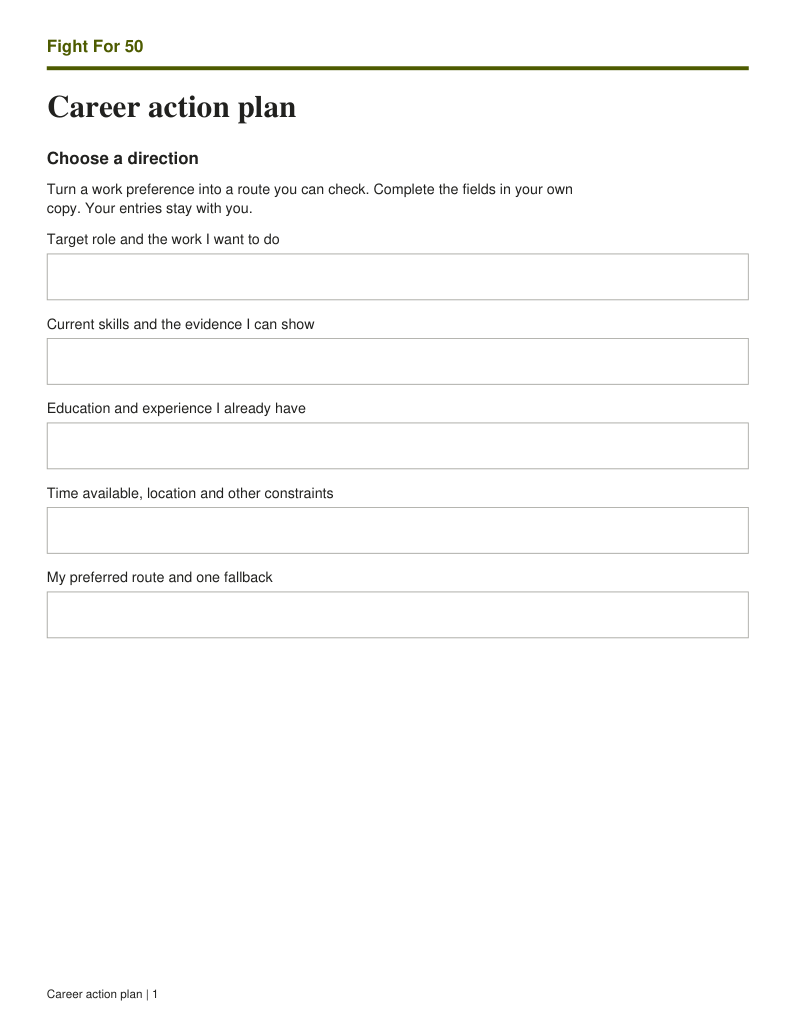
Plan your next career move
Choose a target role, keep one fallback and set out the checks to make next.
For adults choosing a new work direction. Includes a fillable, printable PDF, an editable document, a source checklist and a fictional planning example.
Follow-up emails help you check entry requirements, compare training and choose your next step.
Is there a charge?
The files are free.
How do I get the files?
Links appear after you submit and arrive in your welcome email. Save your copies while the links are valid for seven days.
Can I edit or print them?
Fill in the PDF or edit the document. Print on US Letter or scale to fit A4.
A choice between the three routes
A reader has coordinated office tasks but hasn't led defined projects. They want project support work. The first check is what the target roles ask for, followed by the skills they can show. They shouldn't assume their years in an office automatically qualify them for PMP.
If project basics are missing, a course can be a sensible first learning step. If an external entry credential serves the role, they can inspect CAPM and its education/exam costs. If later records show qualifying project leadership, they can revisit PMP through PMI's current route.
The plan records the next action as a fact to check, not "become successful." Examples include checking an education record, reading a syllabus or drafting a labelled project brief. A concrete action is easier to complete and review than a vague intention to collect credentials.
At the review point, compare the new evidence with the original gap. If the gap is closed, move on. If it isn't, change the learning task or the career direction. You don't need another certificate merely to justify the first choice.
Choose the next credential guide
Return to the online certificate comparison to inspect named programmes and their awards. Follow the appropriate career or credential route from that comparison once you know the work and the requirement. Keep the next step small enough to explain in one sentence.
Is the most expensive award the strongest choice?
Price doesn't establish fit, recognition or eligibility. The useful award matches a real role need and a route you can complete honestly.
Can a course make me eligible for a professional exam?
Sometimes it can meet a defined education requirement. That doesn't mean it waives other conditions. Read the issuer's own rule and preserve the evidence.
What if my target role doesn't require a credential?
Choose learning and practice for the actual skill gap. A clear work sample or relevant experience may be more useful than an unrelated exam.
https://fightfor50.com/certificate-programs/choosing-a-credential/