
6 Six-Month Certificate Routes to Compare for Higher-Paid Work in 2026
We may earn a commission from some links on this page.

Fight For 50 · Facts checked November 2026
6-month certificate programs that pay well need two checks: whether study fits six months and what the occupation actually requires. Compare their study schedules with the full steps into each field. The pay figures are dated occupation medians. A course or certificate does not guarantee a job or higher pay.
The short answer
Google project and IT courses, selected paralegal education and shorter office/bookkeeping courses may fit a six-month study plan. Medical coding needs a course and prerequisite check before its duration can be confirmed.
Start with the schedule and entry rules for the route you want. Potential fit means a published learning estimate can fit if your schedule and entry conditions match. Check the schedule means you need the course dates or workload before judging the fit. A professional exam or experience step may still sit after the course.
Return to online certificate programs if you're choosing by award rather than time. That comparison explains the provider, education and professional award types before you compare schedules.
Our top 6 picks
 1. Google Project Management: a potential fit for foundational study.
 2. AAPC coding preparation: duration depends on the selected route and prerequisites.
 3. BU paralegal education: a fixed programme can fit; entry and later credentials differ.
 4. ExpertRating administrative skills: a short first course, not a professional award.
 5. Intuit bookkeeping education: a short beginner learning option.
 6. Google IT Support: foundational study; CompTIA exams remain separate.
This is a route comparison. It doesn't rank people, employers or expected salaries. For medical coding, check the selected class schedule and any extra foundation study against your six-month limit.
1. Google Project Management course route
The learning estimate can fit six months if you can do the stated weekly work. The award is Google's course certificate through Coursera. It doesn't create the past project leadership needed for PMI PMP.
- Time fit
- Potential fit: Coursera lists six months at ten hours a week; Google describes under six months at five to ten hours weekly.
- Entry
- No prior degree or project experience required for the course.
- What follows
- Work evidence and applications; any separate PMI exam route. CAPM requires age 18, secondary education and 23 hours of project education.
- Cost components
- Google lists USD 49 monthly after a seven-day trial in the US/Canada. Count actual paid months and any separate exam (Source: Google pricing; Checked November 2026).
- Pay scope
- Project management specialists: national median annual wage USD 102,320, May 2025. BLS lists a bachelor's degree as typical entry education.
- Limit
- The occupation median isn't a starting wage for a new course graduate.
- Sources: Google, Coursera, PMI CAPM and BLS project specialists. Checked November 2026.
Use the study time to produce clear project records. A plan, risk note and change explanation can show what you learned when labelled as coursework. Don't let the course title imply you held responsibility for a live client project.
2. Medical billing and coding preparation
Medical coding doesn't have one universal six-month schedule. AAPC offers different teaching modes, and prior medical knowledge changes the study needed. Choose the course and any foundation study first, then compare their schedules with your six-month limit.
- Time fit
- Check the course length, access, workload and medical-subject prerequisites.
- Provider and award
- AAPC preparation; separate AAPC Certified Professional Coder exam.
- Starting knowledge
- AAPC says training needs medical terminology, anatomy and pathophysiology knowledge; additional preparation may be needed.
- What follows
- Exam and any apprentice-status experience conditions. Course completion alone isn't full CPC status.
- Cost components
- Prerequisites, tuition, code books, exam attempts, membership and maintenance. Check bundle inclusions.
- Pay scope
- Medical records specialists: national median annual wage USD 51,140, May 2025. This includes coding; it isn't a medical billing-only series.
- Sources: AAPC CPC, AAPC training and BLS medical records. Checked November 2026.
AAPC lists the CPC exam at $425 for one attempt or $499 for two attempts. Check membership, books and preparation separately. Source: AAPC CPC fees. Checked November 2026.
Don't count only the main coding lessons. A learner new to the medical subjects may need study before those lessons make sense. A route can be attractive while failing a hard six-month limit. If the full route takes longer than six months, choose a narrower first learning goal or allow more time.
3. Paralegal certificate for eligible entrants
Boston University's online Paralegal Studies Certificate is a fourteen-week nondegree programme. That study calendar fits inside six months, subject to its start date and your ability to meet module deadlines. It isn't an unrestricted self-paced finish.
- Time fit
- Potential fit: 14 weeks of teaching, plus the selected start date and any other entry steps.
- Entry guidance
- BU recommends an undergraduate degree or several years of work experience. Check the current programme requirements.
- Award
- BU education certificate; no degree credit and no automatic NALA CP.
- Professional credential
- NALA's CP has its own education/experience categories and exam. An eligible post-baccalaureate route requires the defined degree prerequisite.
- Cost components
- Tuition and included resources; any separate exam. BU's pages show different tuition figures; check the current tuition terms for your intake.
- Pay scope
- Paralegals and legal assistants: national median annual wage USD 62,890, May 2025.
- Sources: BU programme, requirements, tuition, NALA Category 1 and BLS paralegals. Checked November 2026.
BU states that this programme isn't ABA approved. If your target role requires an ABA-approved programme, choose a verified programme that meets that requirement. A shorter course with a different approval status isn't an equivalent substitute merely because it fits the calendar.
4. Administrative support skills
ExpertRating's Administrative Assistant Certification is a possible short introduction. The provider estimates two to four weeks at one to two hours daily. The award is its own course/test certificate, rather than IAAP CAP or a medical office credential.
- Time fit
- Potential fit if you can set aside the stated daily study time.
- Entry
- The course page does not list a formal prerequisite; check the entry terms before paying.
- What follows
- Practice and the actual role's hiring requirements. IAAP CAP has separate paid-experience rules.
- Credential issuer
- IAAP requires four years of relevant paid experience without a degree, three with an associate degree or two with a bachelor's for CAP.
- Cost components
- Provider course/test purchase, possible retake and optional printed certificate.
- Pay scope
- Broad secretaries and administrative assistants group: national median annual wage USD 48,310, May 2025. Subgroup pay differs.
- Sources: ExpertRating, IAAP CAP and BLS administrative work. Checked November 2026.
ExpertRating lists its Administrative Assistant course and provider test at $99.99. This is its own award; any external professional exam is separate. Source: ExpertRating course price. Checked November 2026.
IAAP lists the CAP exam at $400 for members or $600 for non-members. IAAP membership is $200 a year and is optional. Source: IAAP CAP fees. Checked November 2026.
Administrative Assistant Certification
- Best for
- Optional first course in office skills; not IAAP CAP, CMAA or a job qualification
- Trade-off
- ExpertRating’s own award or preparation, not the external professional credential.
Use the remaining months for relevant practice rather than collecting unrelated certificates. A clear spreadsheet, a reliable calendar handoff and a concise email may answer a real skill gap. Label any sample you create for study and avoid using private workplace records.
5. Bookkeeping education
Intuit Academy Bookkeeping on Coursera is beginner education with a course certificate. The current platform estimate is four weeks at ten hours a week. The later Intuit Academy Bookkeeping exam is separate and available to people in the US.
- Time fit
- Potential fit for course study if the workload matches your pace.
- Entry
- Beginner-level course; inspect current enrollment terms.
- Award distinction
- Intuit Academy course completion isn't QuickBooks Online ProAdvisor certification or a public-accountancy licence.
- What follows
- Any selected exam, more practice and employer requirements. Don't add a professional award automatically after finishing the course.
- Cost components
- Monthly course access, any separate exam and the materials you need. Your total depends on paid months.
- Pay scope
- Bookkeeping, accounting and auditing clerks: national median annual wage USD 50,670, May 2025.
- Sources: Intuit Academy programme and BLS bookkeeping. Checked November 2026.
The Intuit Academy Bookkeeping course on Coursera costs $39 a month in the US and Canada after a seven-day trial. Your total depends on paid months. Source: Intuit's Coursera programme. Checked November 2026. Check Intuit Academy for any separate exam terms.
A six-month plan could include course study and further transaction practice. The useful evidence is accurate work you can explain, not an assumed rise in pay. Keep study time separate from the time an employer may need to assess your application.
6. IT support education
Google describes its IT Support certificate as a three-to-six-month learning route. It is a course award for foundational skills. CompTIA separately issues A+ through two matching-version exams. Don't treat one course certificate as both awards.
- Time fit
- Potential fit for the provider-stated study estimate; your weekly workload matters.
- Entry
- No prior degree or experience required for Google's course.
- What follows
- Practical support evidence, any chosen CompTIA exams and applications.
- Vendor credential
- CompTIA A+ needs both current same-version exams. CompTIA recommends hands-on support experience.
- Cost components
- Paid platform periods, optional exam vouchers, equipment and materials.
- Pay scope
- Computer user support specialists: national median annual wage USD 61,860, May 2025. Network support is a different series.
- Sources: Google IT Support, CompTIA A+ and BLS support specialists. Checked November 2026.
CompTIA lists an A+ exam voucher at $274. Core 1 and Core 2 each need a voucher, so two first attempts total $548, before preparation or extras. Sources: CompTIA Core 1 and Core 2. Checked November 2026.
Use safe practice tasks to learn diagnosis and clear support notes. Explain what you tested, why it was safe and how you knew the problem was resolved. That adds meaning to the study without inventing employment experience.
Factors to consider for a six-month plan
Put admission and waiting time before the course. Then add the actual study, assessments and any external exam. Finally list experience, practical or licensing steps that remain. A course that fits six months can still leave a longer route into the work.
Use current BLS medians as context, not a rank of course value. The figures above cover different occupations and entry patterns. Half of workers earn less than a median and half earn more. None of the figures is a new graduate's expected wage.
Compare the complete cash cost as well as the calendar. Include paid access periods and count an included voucher once. A known subtotal can be useful, but don't call it complete while a required amount is missing.
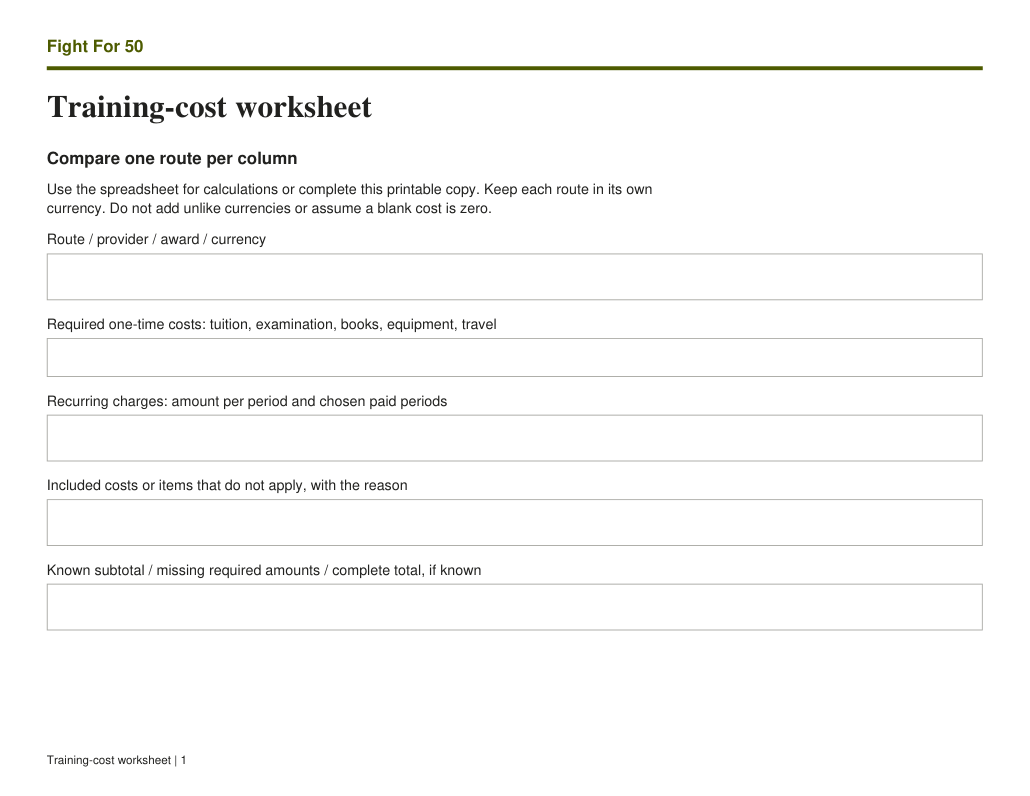
Compare the costs before you choose a course
Keep required, recurring and optional costs separate. See what is still unknown.
For readers comparing training budgets. Includes an editable spreadsheet, printable PDF and formula instructions. No fees or earnings are assumed.
Follow-up emails help you check entry requirements, compare training and choose your next step.
Is there a charge?
The files are free.
How do I get the files?
Links appear after you submit and arrive in your welcome email. Save your copies while the links are valid for seven days.
Can I edit or print them?
Edit the spreadsheet or fill in the printable PDF. Print the PDF in landscape, on US Letter or scaled to A4.
The worksheet keeps missing amounts visible and separates study hours from career-entry timing. Record the actual source and check date for each price. A prior fee from a different country or purchase plan isn't a current quote for your route.
Build the calendar from the start date
Mark the date you can actually begin. A fourteen-week programme that starts after a long wait may not meet your six-month deadline. A self-paced course may start sooner, but its required work still needs room in the calendar. Include breaks you already know about.
Next, place the main assessments and any external exam. Check whether results or documents are needed before the next step can begin. Avoid overlapping tasks that depend on an earlier result. This turns a list of durations into a plan you can use.
Keep one fallback
A useful fallback changes the constraint or narrows the goal. You might extend study, choose a foundation before a larger award or compare a different role. It shouldn't quietly replace a professional qualification with a provider certificate while keeping the stronger claim.
Review the plan after an early piece of work. Compare your actual pace with the estimate, then change the calendar if needed. The point is to finish useful learning within an honest plan. It isn't to preserve an advertised deadline at the cost of practice.
Give each missing fact an owner and next action in your own notes. For a course, that may mean reading the current schedule. For an exam, it may mean checking an issuer's booking window. Don't mark the whole route ready while you still need one of those dates or terms.
If you expect to finish before six months, decide what the spare time is for. It may be further practice or gathering application evidence. It doesn't shorten an experience rule or create an external exam pass. Keep that remaining work named rather than treating free calendar space as proof that you're ready to enter the career.
What still follows the course
Finish with a next-step list, not an assumed job date. One reader may need a professional exam. Another may need work samples, an experience record or a longer education route. A short study award doesn't erase those differences.
If no option meets your hard limit, use the programme comparison to choose a longer route. You can also narrow the first learning goal while keeping the full career plan visible. Check the full qualification length before committing to a six-month plan.
Questions about time and pay
Are all six options verified six-month qualifications?
No. Several have a potential study fit, while coding needs a course and prerequisite schedule check. External credential and job-entry steps are separate.
Does a higher occupation median mean a better course?
No. A median describes workers in that occupation. Compare duties, entry rules and your actual learning need before price or pay context.
Can I use the six-month deadline as my job-start date?
No. Study completion, exam scheduling and hiring aren't the same milestone. Plan them separately and keep unconfirmed time visible.
https://fightfor50.com/certificate-programs/6-month-high-pay/